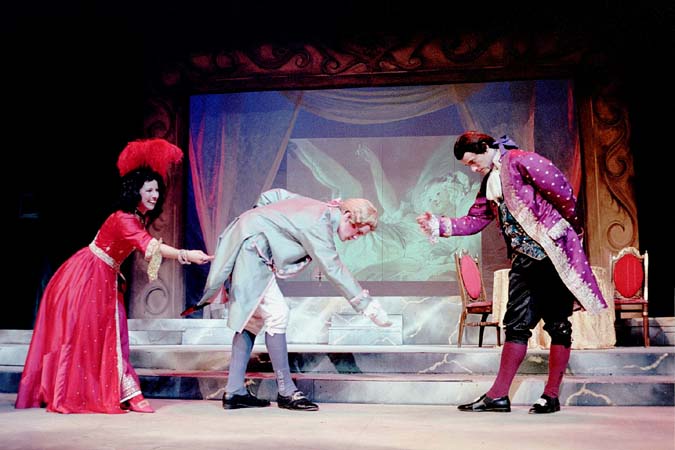
The Great Stage Directors: 100 Distinguished Careers of the Theater
by Samuel L. Leiter 0816026025
Director reads. Two things you should do right away -- read through the textbooks + read Hamlet. In fact, it would be better, if you do it before we see each other for the first time in class.
Kids, I have no time for anything, I resigned from a few editing positions -- I have to work on own books-in-progress. This "progress" has to come to its end. So I advertise myself and my books. Write your comments, while the books are in progress.
Thanks.
Anatoly 2001
Recommended:
DIRECTING PLAYS by Don Taylor A Theatre Arts Book, 200 pp $20.95
To follow your textbook, see Script Analysis for periods, styles and theories
Read the directors and by the end of this semester, you will get a feeling, that all are working in the same direction: developing new languistic abilities of the stage languages. I say "languages"! Set, lighting, sound... only for a general purpose we can combine them under the name "design": in fact, they are the directorial tools -- and without them modern spectacle is impossible (Broadway is the extreme case).
My advice to directors is to recall the three main princinples of TEXTURE in the Aristotlian The Poetics: Language, Music, Spectacle. What if I am to position in order of priority:
SHOW
MUSIC
LANGUAGE
Did you notice that that king of the stage (Language), whcih was the story of history under the name of "History of Drama" is not in the first place. We say "SHOWBUSINESS" -- we insist on SEEING, not hearing!
Play Directing: Analysis, Communication, and Style, 6/E * Francis Hodge 0-205-41923-2
The authors emphasize that the role of the director is not as a dictator, but as a leader of artists working in collaboration who look to the director for ideas that will give impetus to their fullest, most creative expressions.The text emphasizes that directing is not a finite and specific “system” of production, but rather is a means for providing an intensive look at the structure of plays, of acting and actor-ownership, and of all the other crafts that together make a produced play.
The Work of Living Art: A Theory of the Theatre by H. D. Albright, Adolphe Appia, Barnard Hewitt; University of Miami Press, 1960 - Adolphe Appia and "The Work of Living Art"
- Preface
- 1. the Elements
- 2. Living Time
- 3. Living Space
- 4. Living Color
- 5. Organic Unity
- 6. Collaboration
- 7. the Great Unknown and the Experience of Beauty
- 8. Bearers of the Flame
- Designs
- Adolphe Appia's "Man is the Measure of All Things" (protagoras)
Drama / Theatre / Performance by Simon Shepherd, Mick Wallis; Routledge, 2004 - Part One: A Genealogy
- 1: Drama and Theatre as University Subjects
- 2: Drama and the Literary Tradition
- 3: History, Theatre, Society
- 4: The Essence of Drama
- 5: Women, Theatre and the Ethics of the Academy
- 6: Performance, Art and the Avant Garde
- 7: The Rise of Performance Studies
- 8: Performance Studies: Some Basic Concepts
- 9: Postmodernism and Performance
- 10: Recent Mappings of Drama-Theatre- Performance
- Part Two: Keywords
- Action
- Aleatory
- Catharsis
- Character, Mask, Person
- Defamiliarisation and Alienation
- Embodiment
- Empathy
- Interculturalism
- Kinaesthetic
- Mimesis
- Performativity
- Presence and Representation
- Semiotics and Phenomenology
* Spring 2005/06/07 Textbook: The Director's Eye [ hyperlinked to the subject pages ]
Part I -- Basics Chapter 1. Theatre & Life
2. The Nature of Theatre
3. The Role of the Director 4. Finding the Dramatic Action
Assignments & Summary
Part II -- Rehearsals Chapter 5. Entering the World of the Play 6. Mindset
7. Those Powerful Words
8. These Things We Do
9. This Incredible Place
10. Rhythm
Part III -- Script 11. Analysis, Discovery and Images
12. The Rehearsal Unit
13. Life's Rhythms and the Scoring of the Play
14. The Concept Statement
Assignments & Summary
Part IV -- Style 15. An Intro to Style 16. Style and the Creative Process
17. The Theatre and Style
18. Ritual and the "Holy" Theatre
19. The Deceptive Challenges of Comedy
20. Comedy: Nuts and Bolds
21. Choosing Models and Labels
Assignments & Summary
Part V -- Working with Your Collaborators 22. Communicating with Actors 23. Memorization: The First of Five Golden Rings
24. Emotion, Gestation, Boarding and Function: The Other Golden Rings
25. Working with Playwrights, Designers and Others (Stage Manager)
Assignments and Summary
Part VI -- Theatrical Space 26. Theatrical Space: A Meeting Place for Actor and Audience
27. The Director's Approach to Space 28. Design in Space: Sharing Responsibilities
29. Guidelines for Blocking (Mise-en-Scene)
30. Blocking: Lenses for Viewing
31. Blocking: The Bigger Picture
Assignments and Summary
Part VII -- The Whole Picture 32. From Scenes to Plays
33. Rehearsal Progression
34. The Critic and the Director
35. Miracles, Changes and Basics
Assignments & Summary
After Theory of Directing required reading, post 200-word papers on Directing ONLINE (all students in class must subscribe).
Use the Homework and Questions sections for guidence.
Read the pages on HOW to write papers. Also, use the archives of directing classes for samples.
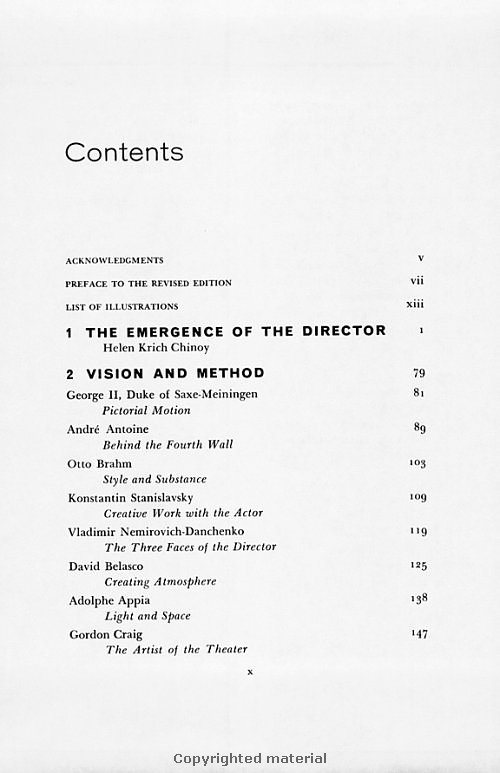
The textbook (see contents) has two main parts: Vision and Method, and The Director at Work -- we will try to cover both (most of it). In the syllabus I use the pages from the 1990 edition.
We won't touch part 4. Staging Shakespeare: A survey of the Current Problems and Opinion. You many use it as a ference, while working on 12th Night and Hamlet, the period stages won't be graded in class.
Part 3. Director At Work should give you a better idea about what "directorial process" is required. Please, read part 2 before reading part 3.
Recommended:
Play Directing: Analysis, Communication, and Style (5th Edition)
Directing for the Stage (Stagecraft)
Stage Directions Guide to Directing (Stage Directions Guides)
Stage Directing, A Practical Guide * Chris Baldwin
An illustrated, hands-on guide written for all those involved in stage directing, particularly students, amateurs, and experienced stage directors.
144 pp • 6 1/2 x 9 • 54 b/w photos, 6 diagrams
1 86126 603 0 • April • $29.95 Paperback Original • The Crowood Press
One good look at your textbook, shows that this history of directing is short -- 20th century only. Easy to remember and understand -- this is is the Age of Cinema! Is there some main tendency we can notice in developing many directorial method and style? After reading Appia (138) and Craig (147) we know that DIRECTING is NEW TECNHOLOGY of theatre. With Meyerhold and Brecht it's became obvious; they understood the nature of SPECTACLE had chage, because the PUBLIC chnged (part 4 of our studies). As a result the Directorial Revolution changes the drama and acting. The Moscow Art Theatre (Stanislavsky & Nemirovich-Danchenko) had no lesser impart on Chekhov' writing, then Chekhov' plays on the forms of their theatre. The obvious case -- Bercholt Brecht himself: director, who writed for himself.
Did you see the SHOW formula on the top of the page? What is this "f"? Function! Director!
THE DIRECTOR AT WORK

Step One: Selecting the Playscript.

Step Two: Analyzing and Researching the Playscript.
A. Structure.
B. Acts, Units, and Beats.
C. Character.
D. Meaning.

Step Three: Conceiving the Production.
A. The World of the Play.
B. What the Audience Hears.
C. Helping the Audience to See: The Ground Plan.

Step Four: Casting the Production: The Ideal and the Real.

Step Five: Rehearsing the Production: Staging, Shaping Polishing.
A. Stage Basics.
B. What the Audience Sees: Composing the Action.
C. What the Audience Sees: Picturing the Action.
D. Actors Must Learn Lines So Directors Can Shape the Action.
E. Intensifying the Action: The Actor.
F. Polishing.

Step Six: Giving and Receiving Criticism.
ABC of Stage Technology
Directing Plays (Theatre Arts)
Directing Plays explores both the theory and practice of directing plays, with particular emphasis on textual interpretation. Don Taylor guides the student through the complex process of choosing a play, the working partnership of director, playwright and designer, the delicate matter of casting a play, the rehearsal process and everything which needs to happen before the production is up and running.
Stage Directing: A Practical Guide
Directing for the Stage
by Lloyd Anton Frerer
Directing for the Stage explores the rudiments of the theatre director's role and responsibilities by walking you through the various phases of a theatrical production.
Overview: Directing for the Stage explores the rudiments of the theatre director's role and responsibilities by walking you through the various phases of a theatrical production.
Features: "The Process of Directing" explores the director's tasks at the beginning of a production--namely, choosing, analyzing, and blocking a play.
"Before Rehearsals Begin" illustrates more in-depth script analysis (in both theoretical and practical terms)and the audition and casting process.
"Rehearsing the Play" discusses the relationship between directors and actors, staging crown scenes, and the rehearsal process.
"Further Considerations" investigates directing challenges that arise with thrust and central staging and examines the different dimensions involved in directing musicals and motion pictures.
Table of Contents
Preface

Part 1: The Process of Directing

Chapter 1: Responsibilities of the Director
Chapter 2: Staging a Scene: The Analysis
Chapter 3: Staging a Scene: The Blocking

Part 2: Before Rehearsals Begin

Chapter 4: Choosing the Play
Chapter 5: Script Analysis: Conflict Structure
Chapter 6: Script Analysis: Possibilities
Chapter 7: Script Analysis: Practical Challenges
Chapter 8: Script Analysis: Examples
Chapter 9: Audience Reaction
Chapter 10: Auditions and Casting

Part 3: Rehearsing the Play

Chapter 11: The Relationship Between Director and Actors
Chapter 12: Principles of Arrangement
Chapter 13: Staging Crowd Scenes
Chapter 14: Creativity in Rehearsal
Chapter 15: Blocking Rehearsals
Chapter 16: Polishing Rehearsals
Chapter 17: Preparing for Performance

Part 4: Further Considerations

Chapter 18: Central Staging and Thrust Staging
Chapter 19: Directing the Musical
Chapter 20: Directing the Motion Picture

Glossary

Bibliography

Index
Edges of Loss : From Modern Drama to Postmodern Theory (Theater: Theory/Text/Performance) (Hardcover)
by Mark Pizzato 0472109146
Read. A lot. And not just textbooks.
Good books.
One day I will get to the writers who changed my life. [theatre theory]


 Meyerhold @ Work *